|
||||||||||||||||||||||||||||||||||||||||||||||||||||||||||||||||
 |
||||||||||||||||||||||||||||||||||||||||||||||||||||||||||||||||
 |
||||||||||||||||||||||||||||||||||||||||||||||||||||||||||||||||
Frequently Asked Questions
They might not be “frequently asked” per se, but the following are issues that tend to pop-up from time to time in the study of Spanish. Why Learn Spanish?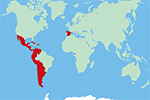
Spanish Speaking World The Spanish language is spoken as a first language by over 400 million people making it the second-most spoken language in the world after Chinese. It is the second-most spoken language in the United States (spoken by over 30 million people) and it is a very popular language to study in U.S. schools. Spanish is one of the easier languages for native English speakers to learn thanks to regular grammar, consistent pronunciation, and a large number of similar words sharing Latin origins. Speaking of Latin, learning Spanish can help improve your vocabulary because many terms relating to math, science, law, medicine, and theology originated in Latin, and Spanish is one of Latin’s closest living relatives. World travellers find Spanish a very useful language as it gives them access to a large number of countries and an enormous geographic area, most of the Western Hemisphere, in fact. Spanish also is a great starting point for learning other romance languages such as Portuguese, French, and Italian. Spanish is one of the six official languages of the United Nations. Español or Castellano?It isn’t entirely accurate to use the term “Spanish” to refer to the language of Spain. Spaniards speak many distinct languages and dialects including Aranese, Basque, Catalan, and Galician. The official language of Spain (spoken by 99% of the population as a first or second language) is actually known as castellano (Castilian) because it originated in the Castilla (Castile) region of Spain. You can use the term español to refer to a person from Spain, but you’re better off using castellano to refer to the language he speaks. Even some countries in Latin America will refer to their language as castellano rather than español. What is the Best Way to Learn Spanish?Two words: Total. Immersion. No matter how good your teacher, your software, or your favorite website is, until you are forced to speak a different language continuously, improvement will be modest. You will never be truly bilingual learning from a book; a language has to be heard and spoken. Spending significant time in a Spanish-speaking country will rapidly expand your vocabulary, improve your reading and listening comprehension, and increase your confidence. You’ll also have the benefit of experiencing the culture first-hand. Many colleges and universities offer semester abroad programs aimed at a teaching foreign languages. There are also many language schools in Latin America for those who can afford to spend a few weeks or months living outside the United States. Traveling not going to work out? The advantage of total immersion is that English isn’t an option, but you don’t necessarily have to move to get good practice. Find a local language program with native speakers who will push you to hear and speak Spanish. Find a conversation partner or group where English isn’t allowed. Find a Spanish speaker interested in practicing their English and have a second-language-only session. If those options aren’t practical but you still want to improve, there are many other ways to surround yourself with authentic Spanish: 
Say “hola” to Lola, Abelardo, and Pancho.
See also: Spanish Language Newspapers Whatever you decide to do, focus on building up your vocabulary. Yes, grammar is important, but correctly conjugating verbs won’t get you very far if you don’t know any other words to add to the sentence. Is Spanish the Same the World Over?No. Not even close. While it would be very nice to learn a language that was totally consistent from one country to the next, the truth is that you will experience some major differences traveling from one Spanish-speaking country to another. The biggest variations occur between Spain and Latin America. One prime example is the vosotros conjugation which is used almost exclusively in Spain while the rest of the Spanish-speaking world uses ustedes. There are also some key differences in pronunciation and vocabulary. For example, several regions in Spain pronounce “c” and “z” with a slight lisp (e.g. “Valencia” sounds more like “Valenthia”). A computer might be referred to as an ordenador in Spain whereas elsewhere it would be called a computadora. But even Latin American countries can vary greatly from each other. 
“Coche” or “Carro”? Central Americans have a tendency to drop the “-s” at the end (and sometimes even in the middle!) of words when speaking, and they also use a (rarely taught) vos conjugation when talking with close friends. Vocabulary is also an issue between Latin American countries. A car can be a coche on one side of the border and a carro on the other. And there is a seemingly endless supply of words for “pig,” like cerdo, puerco, chancho, cochino, marrano, etc. Much of this variety can be attributed to the history of each country. Some regions have close ties with Spain and Europe and are therefore influenced by languages like French and Portuguese. Countries with closer ties to the United States (like Mexico) have been influenced greatly by (American) English. Many countries in Latin America use words adopted from indigenous cultures. And every country has their own set of slang words and idiomatic expressions that won’t make much sense elsewhere. Most Spanish curriculums (as well as this website) try to present a “generic” or international version of Spanish which will be useful in a majority of places and situations. By the way, the country of Spain considers itself to be the official keeper of the Spanish language which is known as Castellano (“Castillian” in English). If you find it upsetting that Spanish is so different from one place to the next, English is really no different. In London, a subway is a “tube,” a flashlight is a “torch,” an elevator is a “lift,” and french fries are “chips.” In fact, George Bernard Shaw once wrote that “England and America are two countries divided by a common language.” While we’re on the subject… What’s the Deal with Vos (Voseo)?Note: Due to the fact that “v” and “b” are pronounced nearly identically in Spanish, vos can sound more like “bos” in conversation. In some Spanish speaking countries (especially in Central America and the southern cone of South America) there is another second-person, singular pronoun in addition to tú and usted. It’s vos. And this phenomenon is known as voseo. Vos is not just a shortening of vosotros or an object pronoun (like nos); it functions as a subject pronoun. Vos is used for very informal situations such as between close friends. In some places vos is used together with tú. In other locations tú is either replaced by vos, or tú becomes more formal and usted isn’t used. The vos has its own set of rules for conjugations. 
Argentina beats to your rhythm. Vos conjugations sound like tú conjugations with the accent shifted to the last syllable. The rule you should follow is to remove the “-r” from the infinitive, replace it with an “-s” and add an accent to the preceeding vowel. Compare tú form and vos conjugations:
As you can see from this small sample, stem changing verbs do not change in the vos form, some verbs are exactly the same in the vos, and some verbs are completely irregular (of course). To form a vos command, you will usually
remove the final “-s” from the conjugation: What Does Se Mean?See the lesson, What Does Se Mean? What’s the Deal with Haber?Actually the word haber doesn’t appear in Spanish all that often but its conjugations do, and they can cause some confusion. Haber is a strange verb that, when used by itself, doesn’t really have an English translation; the closest we can get is “to be” in the sense of “to exist.” It’s easier to see what it means after we conjugate it. In the present tense, haber is conjugated hay, “there is” or “there are.” Haber has a limited set of conjugations. There is only one conjugation in each tense: the third person singular form. You can’t conjugate haber in the yo form or the tú form, for example, because you can’t say things like “I there is,” or “You there are.” But haber can be conjugated in other tenses (and moods). Some examples: Note: According to one theory, the caribbean island of Aruba got its name from the Spanish oro hubo, meaning “there was gold.”
See also: Perfect Tenses Haber can also be used as an auxiliary verb together with a past participle to form perfect tenses (present perfect, pluperfect, future perfect, etc.) When used this way, it means “to have” (as in, “to have seen,” “to have done,” “to have written,” etc.) and it has a complete set of conjugations. (See Perfect Tenses for a complete breakdown of haber conjugations.) There are also some of common idiomatic expressions that involve “haber”: Había una vez… No
hay de qué. ¿Qué hay? / ¿Qué
hay de nuevo? ¡Qué hubo! or ¡Quihúbole! Using a form of haber together with que and an infinitive expresses the idea of being necessary or very important: Hay
que comer mucha fruta. Habrá
que salir muy temprano. What’s The Deal With Puerto RicoNote: Puerto Rico competes in the Olympics as an independent country. Puerto Rico, an island in the Caribbean, has a unique, complicated, and often misunderstood relationship with the United States. When Columbus set foot on Puerto Rico in 1493 the island became part of the Spanish empire. The Spanish conquistadores quickly enslaved the indigenous population who were nearly decimated by disease and brutal working conditions. There were various attempts to gain independence from Spain over the next 400 years, but in 1898, as an outcome of the Spanish American war, Puerto Rico was ceded to the United States (along with Cuba, Guam, and the Philippines). It became a U.S. territory. Since that time the U.S. has granted more and more autonomy back to the islanders themselves through a series of laws and acts (most notable the Jones-Shafroth Act in 1917). And as it stands now, Puerto Rico is “commonwealth” of the United States. The Spanish term is for this is “Estado Libre Asociado” which translates, “Free Associated State.” 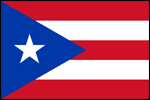
Puerto Rico’s Flag… 
or Puerto Rico’s Flag? Here’s where it gets complicated. Puerto Rico (which is similar in both population and area with the state of Connecticut) is not a U.S. territory or U.S. state, but Puerto Ricans are all U.S. citizens. Puerto Ricans do not need passports to travel to and from the U.S. and do not have to pay Federal taxes, but they cannot vote in Federal elections and they can be drafted into in the U.S. military. So how do Puerto Ricans feel about all of this? There is a group in favor of becoming completely independent from the U.S.; a group in favor of the status quo; and there is a group in favor of becoming the 51st state of the United States of America. Puerto Rico has held a series of referendums regarding U.S. statehood and the percent in favor has grown from 40% in 1967 to 58% in 2024. (A 2024 YouGov poll found that 59% of Americans support Puerto Rican statehood.) The term “Puerto Rican” can also be a confusing one. “Puerto Rican” can refer to a permanent resident of the island of Puerto Rico as well as to someone who has emigrated from the island to the U.S. It can also be used to refer to anyone living anywhere who simply has Puerto Rican ancestry. How Do You Say “I Have Been Studying for Hours”?A present perfect continuous conjugation like, “I have been studying for hours,” or, “We have been driving for days,” is a good example of why you shouldn’t try to translate certain Spanish expressions one word at a time. If you did, you’d end up with something like “Yo he estado estudiando por horas.” While you would probably be understood, there is a better way to say it in Spanish. You’re going to say something a lot more like “It makes hours that I study.” The formula is this: hace + time period + que + present tense Examples: Hace
días que conducimos. Hace
semanas que yo espero. See also: Time Expressions with Hacer We can also write sentences like this in the past tense. In English the “have” becomes a “had.” In Spanish we simply change both of our verbs from the present tense to the imperfect tense. Now you’re saying something more like “It made hours that I studied,” and the formula is this: hacía + time period + que + imperfect tense Examples: Hacía
días que conducíamos. Hacía
semanas que yo esperaba. There are also other ways to use hacer when talking about time. Check out Time Expressions with Hacer. How Do You Say “That” in Spanish?Finding the right word for “that” can be challenging because “that” can function in five different ways: as a conjunction or relative pronoun, as a demonstrative adjective, as a demonstrative pronoun, or as an adverb. Which Spanish word you chose depends on its function. See also: Relative Pronouns in Spanish If you need a conjunction or a relative pronoun, words that combines two clauses, you should use que: Dijo que quería salir. El examen que tomamos fue muy difícil. (As a rule of thumb, if you’re following “that” with a verb, use que.) If you need a demonstrative adjective, a word to specify which object you’re talking about, it gets a little complicated. For masculine objects, use ese, for feminine objects, use esa: Necesito ese libro. Ella va a comprar esa blusa. Ese and esa are used for things which are located in the same general vicinity, but there are other words for things which are farther away, aquel and aquella: ¡Mira aquel coche! Aquella casa es muy bonita. Note: The accents on demonstrative pronouns are no longer required by the Real Academia Española. Ése, ésa, aquél and aquélla can also be used as demonstrative pronouns, meaning “that” or “that one”: Ésa es mi naranja. Aquélla es de Juan. There are also gender neutral or “neuter” pronouns for referring to concepts without gender, eso and aquello: Eso me hace nerviosa. And lastly, “that” can be an adverb modifying an adjective. In Spanish we use the word tan: Tomás no es tan inteligente. How Do You Say “Um” in Spanish?Spanish speakers don’t say “um” but they do use filler words when they have to pause to think about what to say next. Every region has its own unique manner of speaking but there are a few common common Spanish words that work the same way that “um” does in English. Hispanics will often start a response with pues…, entonces…, or bueno… to buy themselves some time to think. All of them translate to “well…”: Pues… no sé que decirte. Entonces… regresemos al coche. Bueno…
es que él es muy nervioso. A ver, which means “let’s see” is another option: A ver… ¿qué piensas de ir al cine? The best translation for “um,” however, is probably este. Many Spanish speakers will use este in the middle of a response when they get stuck searching for the next word: Yo necesito un bolígrafo y… este… tres monedas. Sometimes este gets repeated, sometimes it gets drawn out to esteeeeeee…, and sometimes it just becomes eeeeee…: Ella quiere… este, este, esteeee, ¿cómo se llama?… una orquídea. |
||||||||||||||||||||||||||||||||||||||||||||||||||||||||||||||||
 This work by Spanish411.net is licensed under a Creative Commons Attribution-NonCommercial-ShareAlike 4.0 International License. This work by Spanish411.net is licensed under a Creative Commons Attribution-NonCommercial-ShareAlike 4.0 International License. |